Download document () of 20
 Send email
Download
You have exceeded the download limit
Power demand across a mining site does not always follow renewable generation patterns. Solar output changes by time of day, weather and panel conditions. Wind depends on resource patterns that may not follow your production schedules.
For mining operations, that timing matters because demand often comes from steady, high-priority loads, including:
When renewable output drops during a high-demand period, your site power system needs capacity from storage, backup generation or utility service. When output is high but demand is low, your team needs a plan for how that energy will be stored, used or curtailed.
Comparing renewable resource data with your site load profile shows where wind and solar support operations and where additional capacity or a coordinated control strategy may be needed.
Adding wind or solar to a mining site changes how power moves through every part of your electrical system—not just the energy source.
That can affect decisions around:
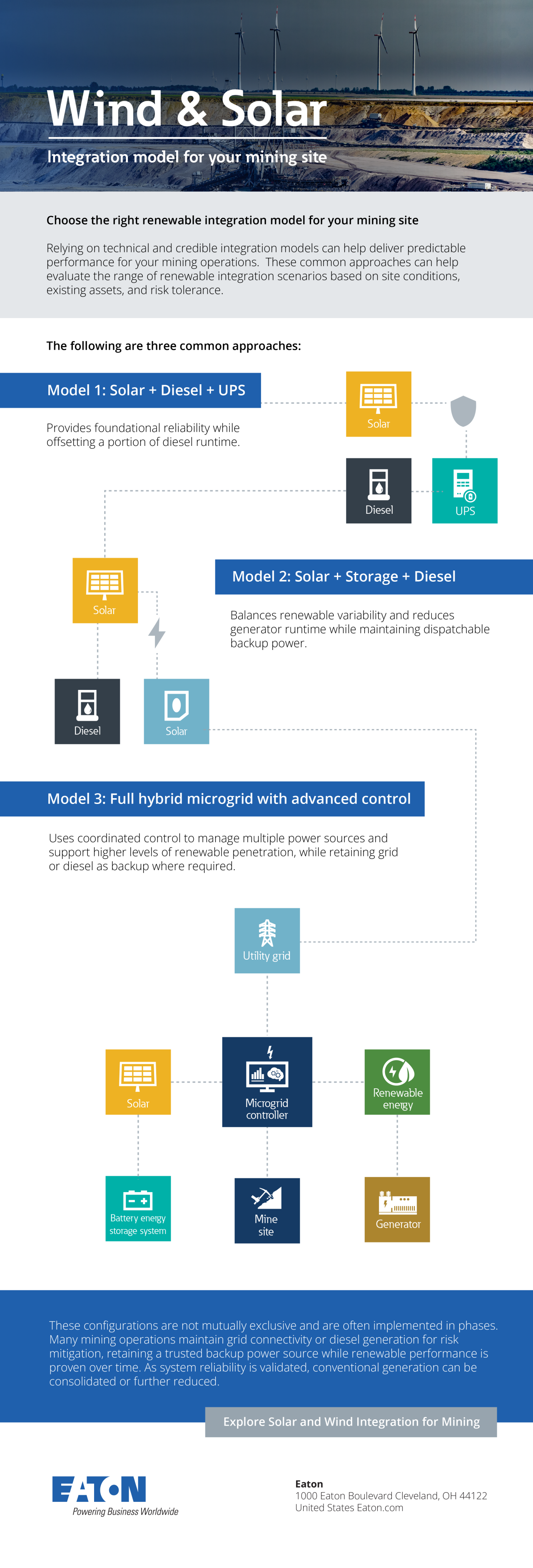
| Renewable condition | System need | Supporting strategy |
| Wind or solar output is high | Use available renewable energy effectively | Store energy or shift controllable loads |
| Renewable output drops | Maintain power to critical operations | Dispatch storage, utility service or backup generation |
| Site demand increases | Avoid overloading existing infrastructure | Prioritize loads and manage available capacity |
| Conditions change quickly | Keep the power system stable | Coordinate generation, storage and load management |
Site conditions constantly change—weather shifts, production schedules vary and grid availability is not guaranteed.
Clear operating priorities help determine which loads stay online, how storage or backup generation should dispatch and how your site power system maintains stability when renewable output changes.
Renewable planning delivers more value when it reflects real operating conditions. Defining renewable fit, variable output and site power requirements helps maintain reliability as demand changes. With expertise across electrical infrastructure, renewable integration, storage, local and system-level control and power system design, you can move from planning to a strategy built for long-term performance. Explore Eaton resources to support wind and solar integration across your mining system design.

 MyEatonFAQs


