Download document () of 20
 Send email
Download
You have exceeded the download limit
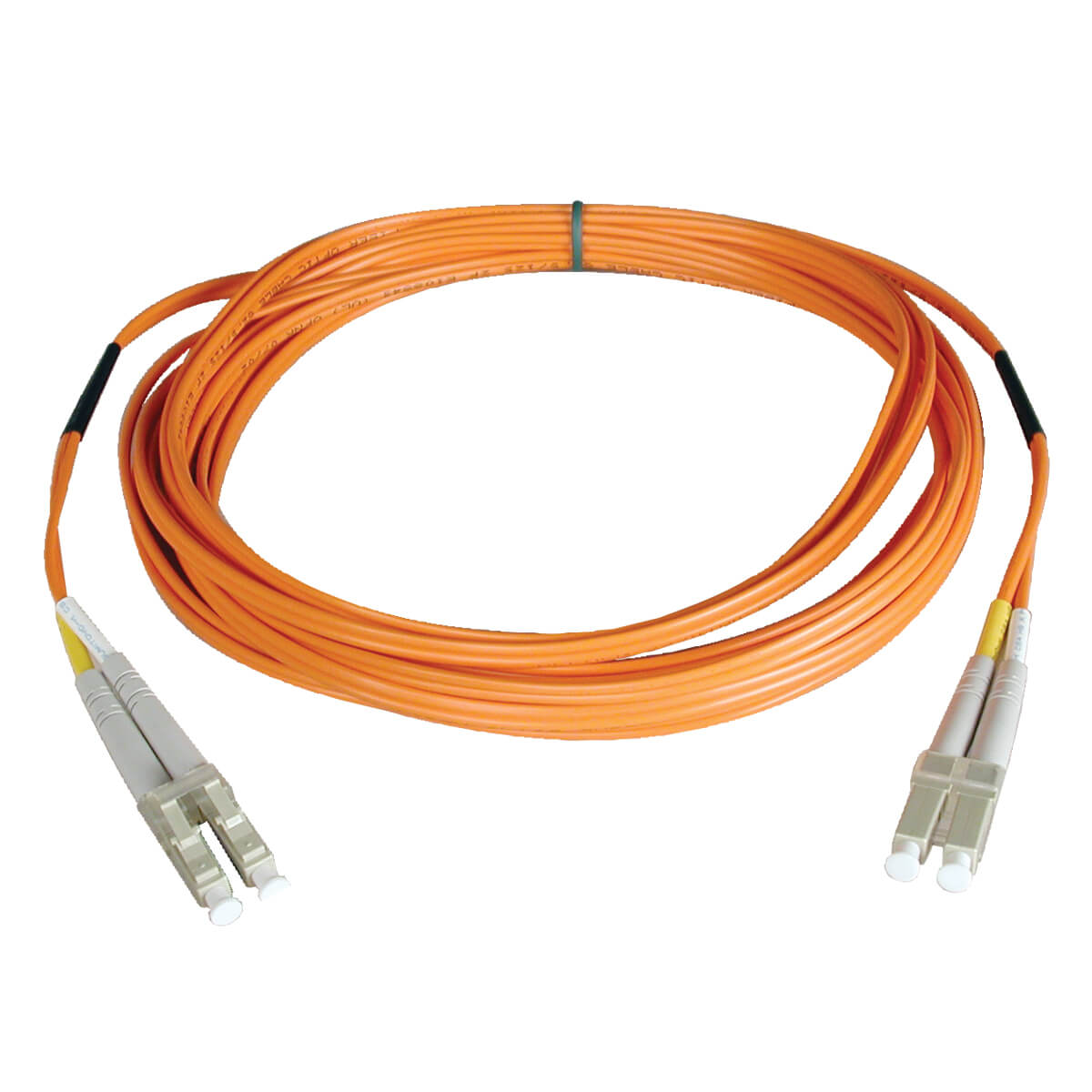
Fiber optic technology offers several key benefits including higher bandwidth for data transmission, longer transmission distances, immunity to electromagnetic interference (EMI), improved reliability and durability and smaller, lighter cables that improve airflow in racks. These advantages make fiber optic cables essential for modern high-speed networks.
Fiber optic cables transmit data using pulses of light instead of electrical signals. Inside the cable you can find a glass or plastic core carries the light signal, cladding that reflects light back into the core and protective coatings that protect the delicate fiber. The light pulses travel down the cable by reflecting off the cladding walls, allowing signals to travel much farther than copper cables without significant signal loss.
How far can a fiber optic cable carry a signal?
Signal transmission distance is dependent on the type of cable, the wavelength and the network itself. Typical ranges are about 984 ft. for 10 Gbps multimode cable and up to 25 miles for singlemode cable. If a longer span is required, optical amplifiers or repeaters can be used to regenerate and error correct the optical signal.
Can the light generated by a singlemode laser damage your eyes?
Yes, the laser light from the end of a singlemode cable or the transmit port on a switch can seriously damage your eyes. Always keep protective covers over the ends of fiber cables and ports.
Fiber optic cable selection can be complex due to the variety of cable types, performance characteristics and more precise installation requirements. Start by determining requirements for the following:
Once you have narrowed down your choices, you should also consider cost and future-proofing. Additional requirements will be driven by the needs of your specific application.
Network Speed and Distance
Multimode fiber (MMF) used to be the automatic choice for datacenters and corporate networks because it was less expensive than singlemode fiber (SMF). Nowadays, the cost difference is not so significant.
Instead of focusing on singlemode vs. multimode, focus on the connection distance and network speed dictated by the overall network design. If you need to move a large amount of data over a relatively short distance (for example, less than 300 meters), OM3 MMF might be the best choice. If data transmission speed or distance are key requirements, consider SMF. Note that MMF range depends on the OM rating of the cable.
Cable Jacket
All indoor fiber cabling must meet local fire codes. In the US, fire rating and jacket identification is defined by Article 77 of the National Electric Code (NEC). If your cable will run through risers or plenum spaces, make sure the cable jacket is rated accordingly.
In addition to fire rating, other cable jacket properties such as flexibility and strength under tensile load should be considered. For more information on jacket materials and fire ratings.
Connectors
Fiber optic cable terminations are typically dictated by the ports on your network equipment. For example, if your 10G Ethernet switch has multi-fiber MTP ports, you'll need cables with the required number of fibers.
If you are selecting cable for a 40GbE or 100GbE application, consider Active Optical Cables (AOCs). They combine an optical fiber cable and transceivers, eliminating the connector entirely.
| Key Requirement | Fiber Solution |
| 10G Server Rack | OM3 or OM4 cable |
| 40G Switch to Switch | MTP, AOC |
| 40G Switch to 10G Servers | MTP-to-LC fan-out cables Break-out cassettes |
| High Port Density | Connectors with push/pull tabs |
| 200/400G Switch to Switch | OM4 with CS connector |
| 200/400G Switch to Switch | OM4 with CS connector |
Jacket material
Most indoor fiber optic cables use a low-cost, fire resistant polyvinylchloride (PVC) jacket. Some installations (e.g. confined spaces, but not risers or plenum) may opt for the more expensive Low Smoke Zero Halogen (LSZH) jacket, which is made of thermoplastic or thermoset compounds and offers superior flame retardant and produces little smoke or toxic fumes when burned.
Polyethylene (PE) is preferred for outdoor applications due to its resistant to moisture and sunlight (UV rays), abrasion resistance and flexibility over a wide range of temperatures.
Jacket color
Colored jackets and connectors are used to identify the mode and OM rating of indoor and military cables, making it easy to identify at a glance the capabilities of a cable and ensuring that installers use the correct cable type for each connection. Outdoor cable jackets are typically black so they can resist damage from the sun, precluding the use of any color coding.
Color code standards and conventions specified in TIA-598D are shown in the table below. Jackets are also printed with additional information about the cable. For example, the jacket of an OM4 multimode cable with core dimensions of 50/125 and a bandwidth of 850 nm laser-optimized might be labeled “OM4 850 LO 50 /125".
| Mode | Cable type | Jacket color | Connector color |
| Multimode | OM1 | Orange | Beige |
| OM2 | Orange | Beige | |
| OM3 | Aqua | Beige | |
| OM4 | Aqua | Light green | |
| OM5 | Lime green | Light green | |
| Singlemode | OS1/OS2 (PC/UPC) | Yellow | Blue |
| OS1/OS2 (APC) | Yellow | Green |
Fiber optic cables use different connector types depending on network equipment and application requirements.
Common connector types include:
The LC connector is one of the most widely used connectors in modern data centers.
Benefits:
LC connectors are commonly used in:
SC connectors use a push-pull locking mechanism and are known for their reliability.
Typical applications include:
MTP/MPO connectors support multi-fiber connections for very high bandwidth applications.
They are commonly used in:
CS connectors are smaller than LC connectors and designed for high-density 200G and 400G networks.
Depending on your application, specialized fiber cables may provide additional benefits.
Active Optical Cables (AOCs) integrate fiber cable and transceivers into a single assembly, eliminating connectors. They are commonly used for short switch-to-switch connections in data centers.
Multi-strand fiber cables include multiple fiber strands in one jacket and support high bandwidth applications above 25G.
Mode conditioning cables allow singlemode signals to run over multimode infrastructure, helping organizations avoid costly upgrades.
Faster data transmission speeds - Photons traveling at the speed of light reach speeds over a hundred times faster than electrons traveling over a copper conductor. In comparing the data transmission speed of fiber and copper, fiber wins easily. Copper currently maxes out at 40 Gbps, whereas OM5 fiber reaches speeds of 100 Gbps.
Higher bandwidth - Fiber optic cables have a much higher bandwidth capacity than copper cables, allowing for more data to be transmitted at once.
Longer transmission distances - Over long distances, copper and fiber cables both experience signal loss, but this attenuation is much greater with copper. Over 100 meters, it is estimated that fiber loses only 3% of its signal strength, whereas copper loses 94% over the same distance.
Immunity to electromagnetic interference (EMI) - Copper wires produce a field of electromagnetic interference, which can cause signaling errors in other cables. Fiber optic cables do not conduct electricity and are not susceptible to EMI.
Electrical isolation - Because fiber optic cables do not carry electricity, there is no need to ground the transmitter and receiver. Nor is there any danger of electrical shock, arcing, heat or fire.
Lighter, thinner cables - Fiber cables are about a quarter the diameter and a tenth the weight of copper cables, making them easier to install and promoting better air flow in rack enclosures.
Better reliability - Fiber optic cables are more durable and less susceptible to damage than copper cables, making them more reliable for high-speed data transmission.
Security - Fiber optic cables are more secure than copper cables because it is difficult for unauthorized users to tap into the data transmission.
Environmentally friendly - Fiber optic cables are made of glass or plastic, which are environmentally friendly materials, whereas copper cables are made of copper, which is a finite resource.
Fiber is often preferred for:
Copper cables are still commonly used for short device-to-device connections.
Fiber is typically used to connect two high-speed devices (e.g. switch to switch) in data centers and campus networks where bandwidth and distance may be critical factors. In residential applications, most telecommunications carriers have adopted some form of Fiber to the X (FTTX), a general term that encompasses configurations such as Fiber to the Premises (FTTP) and Fiber to the Home (FTTH). The last cable run will be defined by the equipment installed by the carrier in the home or business. If the output port is copper, then a standard copper Ethernet patch cable can be used. If the output port is fiber, then a fiber Ethernet cable is needed between the switch or router and the computer. The computer would need a fiber port or a media converter to transition from fiber to copper in order to complete the connection.
The National Fire Protection Association's National Electrical Code (NEC) defines levels of fire resistance for fiber optic cables. Indoor fiber installations are typically classified as plenum, riser or general purpose. Cables installed in plenum spaces and risers must meet standards for flame spread and smoke production outlined in NEC Article 770 and the UL 1651 Standard for Optical Fiber Cable.
UL 1651 defines the following optical-fiber cable types:
| Application | Nonconductive | Conductive | USA test | Acceptable substitute |
| General Purpose All areas that are not plenum or riser on the same space or floor |
OFNG | OFCG | UL 1581 (OFNG) | Riser or Plenum Rated cable |
| Riser A vertical space, typically inside walls and between floors |
OFNR | OFCR | UL 1666 (OFNR) | Plenum Rated cable |
| Space above and below floors typically occupied by heating and air conditioning ductwork | OFNP | OFCP | UL 910 (OFNP) | No substitute |
What's the difference between conductive and non-conductive fiber optic cable?
Non-conductive cables contain nothing that could carry electrical current. Conductive cables include metallic strength members, sheathing or other metal components that could potentially carry an electric current, even though that is not the intended purpose.
Note: Fire regulations vary from country to country. In the US, Article 770 of the National Electrical Code governs installation and testing of premises fiber cabling. In Europe, this falls to the IEC/CEI although individual countries may have their own standards organizations, such as the British Standards Institute (BSI) in the UK.
Several performance factors influence fiber network reliability.
When a pulse of light reaches the end of the fiber core, some percentage of light is reflected back towards the source. This Optical Return Loss (ORL), expressed in decibels (dB), only affects fiber with a laser light source and can reduce data transmission speeds. Singlemode fiber, and multimode fiber with a VCSEL light source, are sensitive to ORL. Older multimode fiber with an LED light source is not subject to ORL.
Are Optical Return Loss and Back Reflection the same thing?
ORL and Back Reflection are often used interchangeably but they are actually different. ORL is the total power lost from all system components, including the fiber itself. Reflected power is only one component of ORL.
Optical Return Loss can be minimized by ensuring that ferrules are clean and connectors are properly mated. It can also be reduced by choosing fiber optic cable with end-faces that are shaped to optimize the physical interface. Original fiber connectors had ferrules with a simple flat face, leaving a relatively large area that could be damaged with repeated mating. Physical Contact (PC) connectors are polished to a slightly rounded surface to reduce the size of the end face. The end face of Ultra Physical Contact (UPC) connectors have an even greater radius so the fibers touch at the apex of the curve near the fiber core.
The ferrules of an Angled Physical Contact (APC) connector are cleaved at an angle between 5 and 15 degrees. The angle directs the reflected light out of the core resulting in a lower ORL value.
Insertion Loss refers to the amount of light lost between two fixed points in the fiber and is measured in decibels (dB). Insertion Loss can occur when fiber is terminated with a connector or spliced, and is often the result of fiber core misalignment, dirty ferrules or poor quality connectors. The combined insertion loss of all system components should be within the limits specified in the link-loss budget agreed with the installer.
Simplex fiber uses a single strand with a transmitter on one end and a receiver on the other, supporting one‑way communication—commonly used in monitoring applications where sensors send data back to a central system. Duplex fiber uses two strands to enable simultaneous two‑way data transmission, with full‑duplex supporting bidirectional flow at the same time and half‑duplex allowing two‑way communication only alternately. Duplex cables are typically used for high‑speed network connections between devices like switches, servers and storage systems.
In duplex systems, polarity ensures that each transmitter (Tx) connects to the correct receiver (Rx). Standards such as ANSI/TIA-598-C define consistent A‑to‑B positioning to prevent polarity errors. Eaton patch cords follow this convention with color‑coded sleeves to indicate connector positions. Because most duplex cables have fixed polarity, switchable‑polarity connectors are used when polarity needs to be corrected, such as when straight‑through building fiber or installation mistakes result in mismatched connections. On these cables, the LC connectors can be swapped by releasing the holding clip, allowing the A and B positions to be reversed.
Explore Eaton’s wide range of fiber optic patch cables, multimode and singlemode fiber cables and high-density data center fiber solutions.
During installation, a fiber optic cable may be stressed when it is pulled through ductwork and around bends. Even pulling a cable from the payoff reel can potentially cause damage. After installation, cables can also be subjected to sustained pulling forces, for example, at cable drops or when run through risers.
The maximum tensile rating of a fiber optic cable is the highest pulling force that the cable can be subject to before the cable's fibers or optical properties are damaged. The cable manufacturer will typically provide two values: maximum tensile rating during installation and maximum tensile rating while in operation.
Fiber optic cable should ideally be pulled by hand in a smooth, steady motion. It should never be jerked, pushed or subjected to excessive twisting.
A passive fiber Traffic Access Point (TAP) allows network managers to monitor live network traffic without affecting performance on the primary link. When used with a traffic monitoring system, TAPs can be used to monitor service quality, enable usage billing and detect security breaches.
Fiber internet, often referred to as "Fiber to the Home" (FTTH) or "Fiber to the Premises" (FTTP), is a type of high-speed broadband internet service that transfers data via fiber-optic cables. These cables are less susceptible to interference or degradation, making fiber internet extremely reliable. It's also capable of delivering much higher speeds, making it perfect for speed sensitive business activities or online gaming.
Fiber optic internet can also provide "symmetrical" speed, meaning that the upload speed is the same as the download speed. This is a significant advantage over many traditional internet services, where upload speeds are often much slower than download speeds.
Fiber To The Home (FTTH) or Fiber To The Premises (FTTP) service usually terminates at a device known as an Optical Network Terminal (ONT), which is installed at your home or business by the Internet Service Provider (ISP). This ONT converts the optical signal from the fiber cable into an electrical signal that your devices can use.
In most residential or small business situations, the ONT will typically have an Ethernet output that you can connect directly to a computer or, more commonly, to a router that provides network connectivity to multiple devices. This is often done with an Ethernet patch cable (Cat6a or higher), not a fiber patch cable.
However, in certain enterprise or high-performance computing situations where a device has a fiber-optic network interface card (NIC), you could potentially use a fiber patch cable to connect the device directly to a fiber network.
Older multimode cables use Light Emitting Diodes (LEDs) as their light source. These LED sources "overfilled" the fiber by using all available paths. Overfilled Launch (OFL) Bandwidth is a measure of the data transmission capacity of cable with an LED source, and is used with legacy fiber cable running at speeds of less than 1 Gbs.
Faster networks require a more focused light source and it came in the form of Vertical Cavity Surface Emitting Laser (VCSEL), pronounced "vixel", a semiconductor that omits a laser beam perpendicular to its surface. Not only was the beam narrower and resulted in lower signal dispersion, VCSELs were also cheaper to manufacture and more power efficient. VCSEL light sources did have one problem though. The light they produced was not uniform across the whole cable core. In essence, the core was "underfilled", with some modes carrying a stronger light pulse than others. It also meant that Effective Modal Bandwidth (EMB) rather than OFL had to be used to measure the performance of multimode fiber.
We know you have many brands to choose from. On the surface, they may all seem alike. It's what you don't see that makes the difference. With Eaton, you get solid engineering, proven reliability and exceptional customer service. All our products undergo rigorous quality control before they are offered for sale, and independent testing agencies verify our products meet or exceed the latest safety and performance standards. Our commitment to quality allows us to back our products with industry-leading warranties and responsive customer service. It's the Eaton difference.

 MyEatonFAQs


